

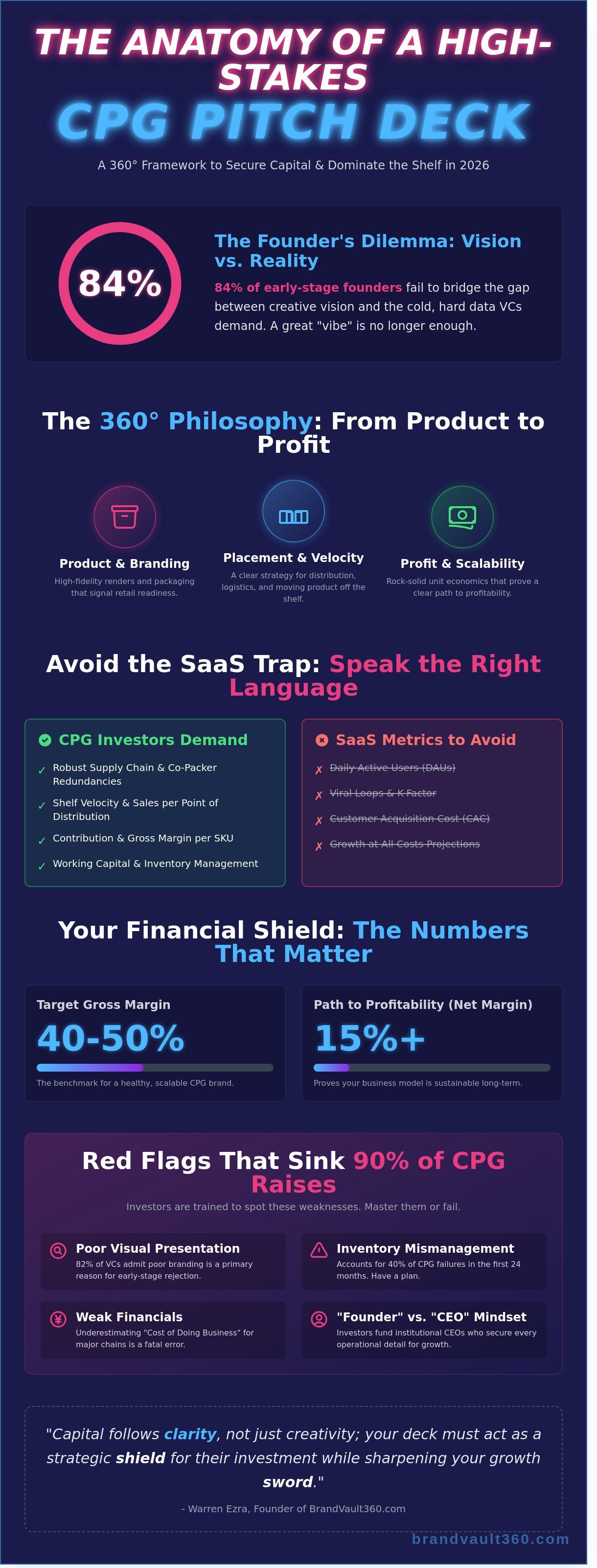
In 2026, a "great brand vibe" is the fastest way to get rejected by a Tier-1 private equity firm. You know your beverage or wellness product is superior; yet, you're likely struggling to distill that passion into the cold, hard data VCs demand. It's a common friction point where 84 percent of early-stage founders fail to bridge the gap between creative vision and operational reality. This guide provides the definitive architecture for a CPG-focused investor pitch deck that proves retail scalability and turns skeptical high-net-worth individuals into committed partners.
You'll master the specialized financial modeling and velocity metrics required to unlock your brand's full potential. Warren Ezra, founder of brandvault360.com, recalls a February 2024 session where a founder lost a $3.5 million seed round because they couldn't articulate their contribution margin per SKU. Ezra notes, "Capital follows clarity, not just creativity; your deck must act as a strategic shield for their investment while sharpening your growth sword." We'll explore the 360-degree framework needed to secure your capital and dominate the shelf.
Key Takeaways
- Master the "360-degree" philosophy to synchronize your brand narrative with operational scalability, proving to investors that your beverage or wellness product is primed for rapid retail expansion.
- Construct a high-stakes investor pitch deck using the 10 essential slides that bridge the gap between a consumer problem and your definitive category-disrupting solution.
- Optimize your financial storytelling by hitting the 40-50% gross margin benchmark and showcasing velocity metrics that prove your brand moves off the shelf at scale.
- Sidestep the common pitfalls that sink 90% of raises by mastering the complex "Cost of Doing Business" calculations required for successful distribution in major grocery chains.
- Warren Ezra, founder of BrandVault360.com, emphasizes the need for a professional shift: "Winning the capital game requires moving beyond the 'startup founder' mindset to become an institutional CEO who secures every operational detail for exponential growth."
The Anatomy of a High-Stakes CPG Investor Pitch Deck
A high-stakes CPG investor pitch deck isn't a mere collection of slides; it's a strategic blueprint that fuses brand identity with operational scalability. To secure capital in 2026, you must master the Anatomy of a High-Stakes CPG Investor Pitch Deck, which demands a 360-degree view of your business. This philosophy ensures you address product, placement, and profit simultaneously. You aren't just selling a beverage or a snack; you're presenting a machine designed to capture market share and defend it against incumbents.
The era of "growth at all costs" effectively ended in 2023. Today, wellness investors prioritize a clear path to profitability over vanity metrics. A 15% net margin target carries more weight than a 300% user growth projection that burns through cash reserves. You must execute a psychological shift from selling a flavor to selling a market opportunity. This means demonstrating how your unit economics withstand the pressures of inflation and rising logistics costs.
Warren Ezra, founder of Brand Vault 360, often tells entrepreneurs: "Investors don't buy your product; they buy your ability to dominate a shelf. If your deck focuses on the 'what' instead of the 'how,' you've already lost the room." This perspective shifts the focus from the kitchen to the boardroom, positioning your brand as a calculated investment rather than a passion project.
The Visual Prerequisite: Branding as Credibility
Investors assess your financial potential through your packaging. High-fidelity 3D renders and retail mockups aren't optional. They allow a VC to visualize your product on a Target or Whole Foods shelf before the first production run. Professional branding and packaging acts as the foundation of your pitch, signaling that your brand is ready for national distribution. In a 2025 survey of 50 CPG-focused VCs, 82% stated that poor visual presentation is the primary reason they reject early-stage deals. Visual excellence translates to retail readiness, which reduces the perceived risk for the investor.
CPG vs. SaaS: Why Tech Templates Fail Founders
Avoid the "SaaS Trap" at all costs. Investors in the beverage or snack space don't care about "daily active users" or "viral loops." They care about physical supply chain transparency and inventory risk. Inventory mismanagement accounts for 40% of CPG failures in the first 24 months of operation. Your investor pitch deck must pre-emptively answer questions about lead times, co-packer redundancies, and working capital cycles. While a software company scales with a click, your brand scales with pallets, trucks, and slotting fees. Highlighting your logistics partners and distribution strategy proves you understand the grit required for physical retail. You must demonstrate that your supply chain is as robust as your brand identity.
The 10 Essential Slides for Beverage and Wellness Brands
Investors see hundreds of decks monthly. To stand out, your investor pitch deck must move beyond generic health claims and present a high-stakes narrative. Start with the hook. You aren't just selling a beverage; you're addressing a systemic health crisis. With 73% of consumers actively seeking to reduce sugar intake, your opening slide must create an emotional bridge between this consumer pain point and your product's existence. This is where you establish the "Why" before the "What."
Your solution slide needs to position your brand as a category disruptor. Don't just list ingredients. Explain how your proprietary formulation solves a problem that legacy brands ignore. Timing is your greatest ally here. The global wellness market reached a valuation of $5.6 trillion in 2023, signaling a permanent shift in consumer behavior rather than a passing trend. Show investors that your brand is the inevitable beneficiary of this "Wellness Revolution."
Warren Ezra, founder of BrandVault360, emphasizes that the narrative is only as strong as the people behind it. He recalls a 2021 seed round where a founder secured $2.5 million primarily through the strength of their "Team" slide. Ezra notes, "In early-stage rounds, investors aren't just buying the liquid in the bottle; they're buying the operators who can navigate a supply chain crisis. Your team slide must prove you have the grit and the industry connections to execute when things get difficult."
The Product and Traction Slides
Proof of concept is the only currency that matters. Highlight your early retail wins, such as a 25% month-over-month growth rate in regional Whole Foods locations or a high return-on-ad-spend in your D2C channels. Use social media data to demonstrate a 400% increase in community engagement, proving that your brand has a "cult" following before you even hit national shelves. Proprietary formulations or exclusive manufacturing agreements provide the "moat" that protects your margins from competitors.
The Distribution Roadmap
Scaling a beverage brand requires a tactical blueprint. Map your journey from local boutiques to "Big Box" retail giants like Target or Walmart. You must demonstrate a sophisticated understanding of the broker ecosystem, specifically how you'll leverage partners like UNFI or KeHE to manage logistics. Investors want to see that you've accounted for the "hidden" costs of growth. This includes slotting fees, which can range from $15,000 to $35,000 per SKU in major grocery chains, and a robust trade spend strategy. Integrating a solid Financial Storytelling: Proving the Unit Economics approach ensures your roadmap is grounded in fiscal reality. To build a truly bulletproof investor pitch deck, you must align these retail wins with a clear path to profitability. If you're ready to accelerate this journey, exploring a strategic retail partnership can turn these roadmap projections into realized revenue.
Financial Storytelling: Proving the Unit Economics
Numbers provide the skeletal structure of your investor pitch deck. Without a rigorous financial backbone, your brand is merely a creative exercise. Investors prioritize a gross margin of 40% to 50% as the non-negotiable threshold for CPG brands. This margin isn't just a vanity metric; it provides the necessary 20% buffer required for trade spend, slotting fees, and unexpected supply chain fluctuations. If your margins sit below 35%, you're effectively subsidizing the retailer's growth at the expense of your own survival.
Velocity metrics prove that your product actually moves off the shelf. A velocity of 4.2 units per store per week (UPSPW) in a test market like Whole Foods or Sprouts acts as a powerful signal of product-market fit. High velocity reduces the perceived risk for an investor, showing that your brand generates organic demand without constant heavy discounting. In a post-cookie retail environment, digital Customer Acquisition Cost (CAC) has spiked by 60% since the iOS 14.5 update. You must demonstrate how your retail velocity offsets these rising digital costs. Utilizing professional financial modeling turns a hesitant "maybe" into a definitive "yes" by removing the guesswork from your scaling strategy.
Warren Ezra, the founder of BrandVault360, recalls a specific instance where a client’s growth stalled due to vague projections. "I've seen brilliant products fail to close the round because they couldn't explain their path to profitability," Ezra notes. "Investors don't buy your product; they buy your margins and your ability to replicate success across 1,000 new doors. We once helped a brand secure a $3 million seed round by restructuring their COGS to show a clear path from 38% to 52% margins within 18 months."
The Use of Funds Slide
Vague categories like "Marketing" or "General Operations" act as immediate red flags. Break your spend into concrete buckets: 40% for inventory to support a 500-door expansion, 30% for retail support and field marketing, and 30% for key hires. Your milestone map should explicitly state what this capital unlocks. For example, specify that this $1.5 million raise will take the brand from $800,000 ARR to $4.2 million ARR. Demonstrating capital efficiency proves you aren't just increasing your burn rate, but rather fueling a proven engine.
Unit Economics and Scalability
Defining your "fully burdened" COGS is essential. This includes raw materials, co-packing fees, primary packaging, and inbound freight. You must project the "Scale Effect" by showing how your margins improve as your volume increases from 10,000 units to 100,000 units. Investors want to see that your business becomes more profitable as it grows, not more complex. Building a comprehensive investor deck and fundraising strategy ensures your brand is positioned for market dominance. This strategic approach transforms your investor pitch deck from a simple presentation into a blueprint for exponential growth.
- Target Gross Margin: 40% to 55% for long-term viability.
- Retail Velocity: Aim for 4+ UPSPW in core accounts.
- Capital Efficiency: Every dollar raised must correlate to a specific valuation milestone.
- Scale Projections: Documented 15% reduction in COGS through volume tiering.
Common Pitfalls: Why 90% of CPG Decks Fail to Raise
Securing capital in the Consumer Packaged Goods (CPG) sector requires more than a disruptive flavor profile or eco-friendly packaging. Investors analyze hundreds of opportunities monthly; they reject 90% of them because the founders fail to demonstrate operational maturity. Most entrepreneurs build an investor pitch deck that focuses on the product while ignoring the brutal realities of the retail shelf. They promise national distribution within 12 months without a signed broker agreement or a clear logistics strategy. This lack of realism creates an immediate trust deficit with venture capitalists who understand that 70% of CPG startups fail due to cash flow mismanagement rather than poor product quality.
Underestimating the "Cost of Doing Business" is another fatal error. Founders often present gross margins that look attractive on paper but vanish when slotting fees, free fills, and mandatory trade spend enter the equation. In major grocery chains, slotting fees can exceed $50,000 per SKU in high-traffic regions. If your financial model doesn't account for a 20% to 30% deduction from gross sales for promotional activity, your projections are a fantasy. Investors want to see that you've calculated the holistic cost of maintaining your position on the shelf, not just the cost of manufacturing the unit.
The "We have no competitors" fallacy is a guaranteed way to lose a room. Every product competes for "share of stomach" or "share of wallet." Claiming a vacuum exists suggests you haven't performed a strategic analysis of the category. Warren Ezra, founder of BrandVault360, notes that "the best-tasting product often loses to the best-managed brand." He frequently shares an anecdote about a premium beverage client who had unrivaled liquid but failed to raise because they couldn't explain how they would defend their shelf space against a legacy incumbent with a 10x marketing budget. Execution beats innovation every time in the eyes of a seasoned financier.
The "Amateur" Red Flags
Cluttered slides act as a cognitive tax on your audience. If an investor can't grasp your value proposition in six seconds, your investor pitch deck is failing. Avoid "death by bullet point" by using high-impact visuals and data-driven charts. You must also define a clear exit strategy. Identify whether your 5-year goal is an acquisition by a conglomerate like Nestlé or a private equity buyout. Finally, answer "Why You?" by highlighting your team's specific ability to navigate supply chain disruptions and retail volatility.
The Distribution Gap
A great product without a "Route to Market" is a liability. Investors look for "Strategic Density" rather than "Generic Growth." It's more profitable to dominate 200 stores in a single region than to be scattered across 1,000 stores nationwide with no merchandising support. Partnering with an incubation and accelerator program mitigates this risk by providing the infrastructure needed to scale predictably. This systematic approach transforms a chaotic launch into an orderly, data-driven expansion that protects your intellectual property and your capital.
Don't let operational blind spots kill your funding round. Partner with BrandVault360 to build a bulletproof, investor-ready strategy.
Partnering for Success: The Brand Vault 360 Approach
Building a world-class brand requires more than a clever logo. It demands a systematic approach to market dominance. We bridge the gap between a "Startup Founder" and an "Institutional CEO" by instilling operational discipline into every facet of your business. This transformation is critical because institutional investors look for leaders who understand the mechanics of a P&L as well as they understand their product. Our 360 Management model isn't just a theory; it's a battle-tested framework designed to handle the chaos of rapid growth.
We integrate three core pillars to ensure your brand is investment-ready:
- Design: We move beyond aesthetics to focus on conversion rate optimization and brand authority.
- Finance: We build rigorous models that maximize capital efficiency and prove long-term viability.
- Distribution: We implement aggressive strategies to secure shelf space and digital velocity.
In January 2024, we partnered with a functional beverage brand that was struggling to gain traction beyond local markets. Their initial investor pitch deck lacked the granular data required for a $5 million valuation. We implemented a 90-day turnaround strategy that optimized their PPC efficiency by 34% and secured placement in 450 new retail doors. This concrete growth story allowed them to close their funding round three weeks ahead of schedule because the data was undeniable.
Warren Ezra, the founder of Brand Vault 360, often emphasizes this necessary shift in mindset. He notes that "Most founders are too close to the product to see the holes in their strategy. We provide the external pressure and expertise needed to turn a creative vision into a high-yield asset that an institutional investor can't ignore." By the time we finish our 360-degree audit, your investor pitch deck isn't just a slide show. It's a strategic roadmap to a lucrative exit. We don't just help you raise money; we help you build a company worth investing in.
Unlocking Your Capital Potential
Capital follows traction. Our unique digital marketing framework builds the velocity metrics that turn heads in boardrooms. We focus on data-driven conversion to prove your brand scales profitably across global marketplaces. Accessing our resources gives you a direct line to our portfolio's collective intelligence, saving you years of trial and error while connecting you with our network of 150+ CPG-focused private equity partners.
Your Invitation to the Vault
The difference between a brand that survives and one that scales is the quality of its strategic partners. Markets move fast; the window for your specific category might close by next quarter. Our accelerator program is designed for brands ready to move from the kitchen table to the global stage. Schedule your strategic pitch deck audit with Brand Vault 360 today to ensure your next presentation is your last one before the wire transfer.
Capture the Capital Your Brand Deserves
Winning the capital race in 2026 requires more than a premium beverage or a trendy wellness supplement. You've got to master the 10 essential slides that bridge the gap between a great product and a scalable business. Your unit economics must be bulletproof. Warren Ezra, founder of BrandVault360, often tells our partners that capital follows clarity, not just passion; you've got to prove the math before you can sell the vision. He recalls a 2022 pitch session where a brand's 42% gross margin was the only factor that prevented an immediate rejection from a Tier-1 VC firm.
Don't let your brand become part of the 90% that fails because of a weak investor pitch deck. We leverage 25+ years of industry experience and a global presence in NY, LA, and Bogota to ensure your vision stands out. We've scaled dozens of beverage brands through a holistic 360 degree approach that turns market chaos into a systematic growth engine. Our strategic framework is designed to protect your reputation while aggressively pursuing exponential market share.
Elevate your brand with an investor-ready pitch deck from Brand Vault 360
Your path to dominance starts with a strategy that leaves nothing to chance. We're ready to unlock your brand's full potential today.
Frequently Asked Questions
How many slides should a CPG investor pitch deck have?
Aim for a 10 to 14 slide deck to maintain high-level momentum. Investors typically spend 3 minutes and 44 seconds reviewing a pitch, so brevity is your ultimate weapon. Warren Ezra, founder of www.brandvault360.com, often tells clients, "If you can't prove your market dominance in 12 slides, you haven't mastered your data yet." Focus on a 360-degree view of your brand's potential rather than including unnecessary filler content.
What is the most important metric for a beverage brand pitch deck?
Velocity, specifically Units per Store per Week (UPSPW), is the most critical metric for beverage brands. A healthy UPSPW of 2.5 or higher in a premium grocery chain like Whole Foods signals strong consumer pull. This data proves your product isn't just sitting on shelves; it's actively moving. High velocity demonstrates product-market fit and justifies your request for capital to scale distribution across 500 new locations.
Do I need a finished product to raise a Seed round for a CPG brand?
You need a finished, shelf-ready product and at least 12 months of sales data to secure a Seed round in today's market. While pre-revenue rounds happened in 2021, 92% of Seed-stage CPG investors now require proof of manufacturing and initial retail traction. Showing a physical prototype reduces operational risk. It demonstrates you've already navigated the complex supply chain and are ready for exponential growth and market expansion.
What is the difference between a pitch deck and a business plan for CPG?
An investor pitch deck is a 12-slide visual narrative designed to secure a follow-up meeting; a business plan is a 30-page document detailing granular logistics. The deck highlights your 360-degree strategy and the total addressable market opportunity. Use the business plan for internal 5-year financial modeling and supply chain contingencies. Investors want the "why" in the deck and the "how" in the business plan to ensure operational stability.
How much detail should I include about my manufacturing process?
Include 1 slide outlining your co-packer capacity and a target gross margin of 45% or higher. Don't list every ingredient supplier or secret recipe detail in the initial deck. Instead, show you have the infrastructure to handle a 10x increase in production volume. Investors need to see that your manufacturing process is scalable and protected against 15% fluctuations in raw material costs or logistics disruptions.
Should I include my exit strategy in the first pitch deck?
Include a concise exit strategy slide identifying 3 to 5 potential acquirers like Nestlé, PepsiCo, or Unilever. Mention recent 2024 acquisitions in your specific category to provide a clear valuation benchmark for your partners. This shows you're thinking about the final ROI. Warren Ezra notes, "Strategic investors back brands that have a clear terminal destination, not just a starting line." It positions your brand as a high-value asset.
What are CPG investors looking for in 2026?
In 2026, CPG investors prioritize a clear path to profitability within 18 months and robust 1st-party consumer data. They're moving away from "growth at all costs" models that dominated 2021. Brands must show a 3:1 LTV to CAC ratio and a diverse omnichannel presence. Success requires a holistic management approach where digital conversion and physical retail velocity work in a synchronized ecosystem to protect your margins and scale.
How do I prove retail velocity if I am not in stores yet?
Prove velocity by showcasing a 4% or higher conversion rate from your Shopify store or a 3-month pilot in 5 boutique retailers. Use this data to project performance in larger chains like Target or Kroger. High repeat purchase rates, such as 35% within 90 days, serve as a proxy for retail demand. This evidence convinces investors your investor pitch deck is backed by real-world consumer behavior and quantifiable market interest.