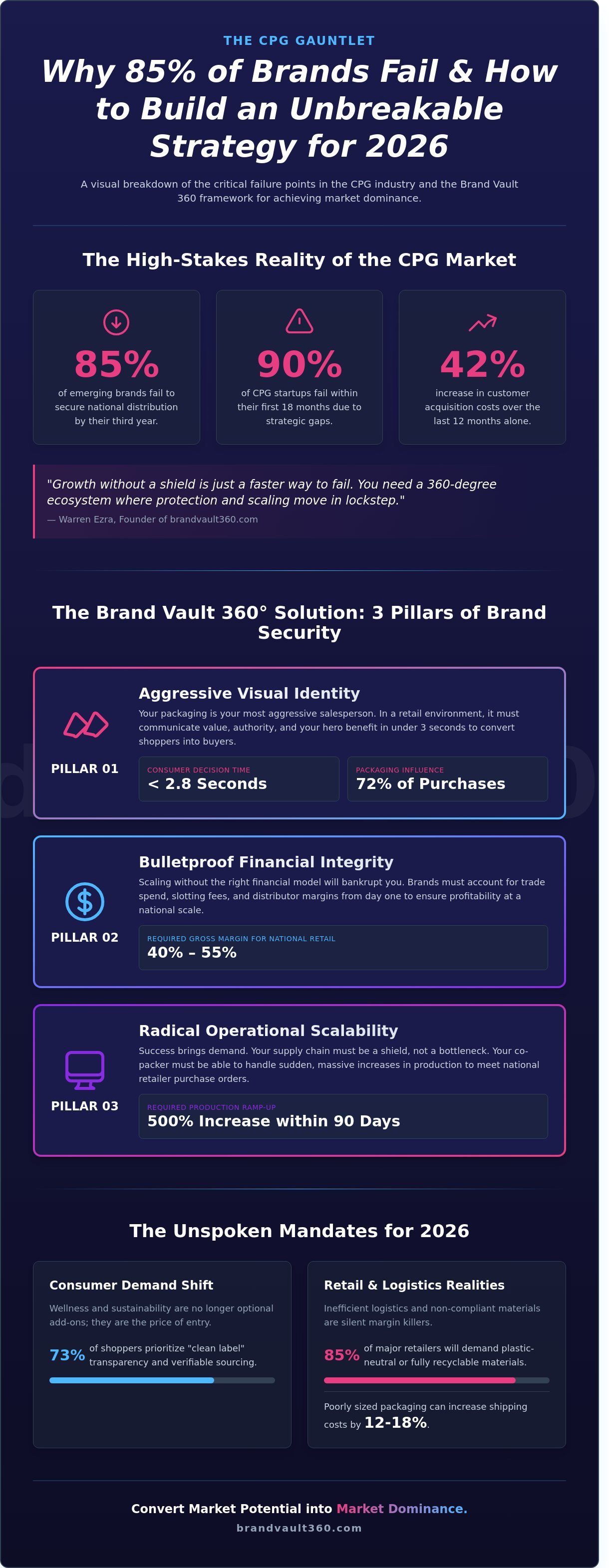
What if the reason 85% of emerging brands fail to secure national distribution by their third year isn't a lack of quality, but a fragmented CPG brand strategy? You've likely felt the sting of a Category Manager's rejection or watched your customer acquisition costs climb by 42% over the last twelve months. It's exhausting to build a premium product only to find yourself trapped in a cycle of supply chain bottlenecks and co-packing delays that erode your margins before you even hit the shelf.
Warren Ezra, founder of brandvault360.com, recalls a 2021 case where a client lost a 450-store rollout due to a single overlooked logistics clause. "Growth without a shield is just a faster way to fail," Ezra insists. "You need a 360-degree ecosystem where protection and scaling move in lockstep to ensure that once you win the shelf, you keep it."
This article provides the vertically integrated framework you need to bridge the gap between initial product design and dominant national retail distribution. We'll detail the exact financial models and operational structures required to achieve sustainable brand velocity by 2026. You're about to transform your operational chaos into a systematic engine for market dominance.
Key Takeaways
- Learn to transition from a digital-only presence to a dominant hybrid model using a vertically integrated CPG brand strategy designed for 2026.
- Discover why optimizing your packaging's visual hierarchy is a strategic financial investment that triggers immediate consumer velocity on retail shelves.
- Master the "Trojan Horse" distribution method to secure niche market wins that validate your brand’s scalability for national wholesale expansion.
- Bridge the gap between operations and investment by building a capital-ready framework that aligns your brand’s growth trajectory with institutional investor requirements.
- Implement the Brand Vault 360 methodology to identify hidden friction points; as Warren Ezra notes, "A 360° audit is the prerequisite for converting market potential into market dominance."
What is a Modern CPG Brand Strategy?
A modern CPG brand strategy is a multi-dimensional roadmap designed to navigate the high-stakes retail environment of 2026. It's no longer enough to launch a product on a digital storefront and wait for the algorithm to provide customers. Success in the current market requires a holistic approach that bridges the gap between digital discovery and physical shelf dominance. Industry data indicates that 90% of CPG startups fail within their first 18 months. These failures rarely happen because the product is poor. They happen because founders lack a scalable framework to handle the transition from direct-to-consumer (DTC) models to complex hybrid retail environments.
Warren Ezra, the founder of BrandVault360, identifies this common pitfall as the "illusion of the great product." Ezra notes, "A superior formula or a unique flavor profile is just the entry fee. The illusion that a great product sells itself is what kills most emerging brands before they hit their second year of distribution. Without a 360-degree strategy, you're just a hobbyist in a shark tank." To survive, brands must treat Consumer Packaged Goods as a game of financial engineering and logistical precision as much as creative marketing.
The Three Pillars of Brand Security
BrandVault360 anchors every successful rollout in three non-negotiable pillars. First, your visual identity must act as your most aggressive salesperson. In a retail environment where consumers make a choice in under 2.8 seconds, your packaging must communicate value and authority instantly. Second, you need financial integrity. You must model for the 40% to 55% gross margins that national retail buyers demand. If you don't account for trade spend and slotting fees early, scaling will bankrupt you. Third, operational scalability is your shield. You must ensure your co-packer can increase production by 500% within a single 90-day cycle to meet the sudden demands of a national retail rollout.
The Evolution of Consumer Packaged Goods
The 2026 consumer is more informed and less loyal than previous generations. Wellness and sustainability are no longer premium add-ons; they're baseline requirements for entry. Research shows that 73% of shoppers now prioritize "clean label" transparency and verifiable sourcing before making a purchase. They want to know exactly what's in the bottle and how the brand impacts the global ecosystem. This shift requires a proactive mindset that anticipates regulatory changes and consumer sentiment shifts before they hit the mainstream. An expert strategist views every label claim as a tool for conversion rate optimization and long-term brand protection. Strategic market dominance is the byproduct of pairing a visionary product with a ruthless, data-driven execution plan that leaves no variable to chance.
Building the Foundation: Identity and Product Design
Packaging design is a financial asset. It isn't a subjective aesthetic choice. In a high-velocity retail environment, your design dictates your margin and your velocity. Data from 2024 shows that 72% of consumers make purchase decisions based on packaging design alone. If your CPG brand strategy treats your box as an afterthought, you're leaving 28% of your potential market share on the table before you even ship a single pallet. Professional design creates an immediate perception of value that allows for premium pricing and higher conversion rates.
The 2026 consumer has moved beyond simple "need" fulfillment. They seek identity. They want products that act as badges for their personal values and lifestyle choices. This shift requires a visual hierarchy that wins in 1.8 seconds. For beverages and snacks, the eye follows a specific path: color, shape, then text. You must lead with your "Hero Benefit." If you're a high-protein snack, that "20g Protein" callout must be legible from six feet away. VCs and private equity firms look for this level of strategic clarity in your pitch deck. They want visual assets that prove you understand the shelf, not just the studio. They look for "shelf-ready" scalability that minimizes operational friction.
Packaging for the Retail Shelf
Logistics drive profitability. Poorly sized packaging that doesn't fit standard 40x48 inch pallets can increase your shipping costs by 12% to 18%. Every millimeter matters. Beyond physical dimensions, sustainability is now a hard requirement. By 2026, 85% of major retailers will demand plastic-neutral or fully recyclable materials. Your digital presence must mirror this physical excellence. High-contrast, "thumb-stopping" renders are essential for conversion on Amazon and DTC platforms. You can unlock your brand's potential by aligning your physical packaging with these rigid digital requirements.
The Warren Ezra Anecdote: Lessons from the Field
Warren Ezra, founder of BrandVault360, recalls a specific snack brand that struggled to gain traction in 2023 despite having a superior product. The original design used muted, earthy tones that blended into the shelf. Ezra advised a pivot to a high-contrast, bold typography style that emphasized "360-degree brand" visibility. By simply increasing the font weight and adjusting the color saturation by 15%, the brand secured a regional trial with a major grocer within 90 days. These small design shifts signaled authority and professional readiness to the category manager. It transformed the product from a "maybe" into a "must-have" for the retailer's portfolio.
This "360-degree" philosophy ensures that no detail is left to chance. From the texture of the matte finish to the QR code on the side panel, every element must work toward market dominance. You aren't just selling a product; you're building a fortress. A robust CPG brand strategy protects your intellectual property while aggressively pursuing shelf space. When your identity is airtight, your scaling becomes inevitable. This foundation allows you to transition from a startup concept to a national retail powerhouse with minimal wasted capital.
Route-to-Market: Analyzing Distribution Channels
Deploying a winning CPG brand strategy in 2026 requires a 360-degree view of the distribution landscape. You'll start by balancing the agility of Direct-to-Consumer (DTC) with the massive volume potential of wholesale. Launching on Shopify or Amazon provides the first-party data needed to convince retail buyers that your product isn't a gamble. It's a proven asset. Success depends on treating DTC as your laboratory and wholesale as your scale engine. By the time you approach a distributor like UNFI or KeHE, you should have a customer acquisition cost (CAC) that's 20% lower than the industry average for your category.
Warren Ezra, founder of BrandVault360, frequently reminds his partners that "Distribution without a protection strategy is just an expensive way to go out of business." He notes that brands often rush into national retail without securing their digital presence first, leading to price wars that erode margins. "I've seen brands with $10 million in venture backing fail because they treated a grocery shelf like a digital storefront. You can't just buy a click on a shelf; you have to earn the square inch of real estate through proven velocity," Ezra explains. This perspective underscores why a tactical approach to distribution is non-negotiable.
Mastering the "Trojan Horse" strategy involves dominating niche, high-influence markets before attempting a mass-market takeover. If you're launching a functional beverage, you don't start at Walmart. You secure placement in 50 high-end boutique gyms or independent health food stores in Los Angeles. This creates an aura of exclusivity and generates a velocity of 4.5 units per store per week (UPSPW), a metric that will make any category manager at a major chain take your call. Managing food brokers requires a similar level of precision. You'll likely face a 25% margin haircut when a distributor enters the picture. You must account for this by building a 65% gross margin into your initial COGS (Cost of Goods Sold) model.
The Retail Buyer Mindset
In 2026, buyers at Whole Foods or Kroger prioritize velocity over raw volume. They're looking for a sales-per-square-foot ratio that exceeds $850. You'll need to prepare for slotting fees that can reach $40,000 per SKU for national placement. Trade spend, including temporary price reductions (TPRs) and end-cap displays, should account for 15% to 20% of your gross sales. Buyers want to see a 360-degree marketing plan that proves you're driving traffic to their aisles, not just sitting on their shelves.
Scaling from Regional to National
Scaling too fast creates a supply chain "death spiral" where out-of-stock penalties can consume 5% of your total revenue. Focus on strategic hubs like NYC, LA, and ATL, which represent 40% of early-stage CPG volume. By concentrating your CPG brand strategy on these regions, you maximize logistics efficiency and build a dense brand presence. Once you've achieved a 3.8x return on trade spend in these markets, you're ready for the national stage. For more granular details, check out The Playbook for CPG Retail Distribution Strategy to ensure your logistics keep pace with your ambition.
Investor Readiness: The Financial Side of CPG Strategy
Execution requires capital. If your CPG brand strategy lacks a clear roadmap for funding, you've built a ceiling over your growth before you've even launched. Investors don't buy products; they buy scalable systems. They look for evidence that your brand can move from a local pilot to 2,500 doors without collapsing under the weight of its own supply chain. Your strategy must prove that every dollar invested generates a predictable, exponential return.
An investor-ready pitch deck for 2026 must include five non-negotiable components. First, you need Market Validation through Total Addressable Market (TAM) data. Second, you must show Velocity Data, specifically units per store per week (UPSPW) from initial test markets. Third, your Margin Scalability must account for a 15% to 20% trade spend. Fourth, you need an Operational Moat, such as proprietary formulations or exclusive sourcing. Finally, a clear Exit Strategy identifies which strategic acquirers are currently buying in your category.
Avoid the valuation trap that crippled many startups in 2023, where overvalued brands faced 40% valuation cuts in follow-on rounds. Setting an unrealistic price tag today creates a "down round" risk tomorrow. High valuations demand high performance; if you don't hit your numbers, your equity gets crushed. Brand Vault 360 acts as a strategic bridge, utilizing a 360-degree vetting process to connect founders with PE and VC firms that specialize in high-growth consumer goods.
"I've seen founders focus 90% of their energy on package design while their unit economics are bleeding out," says Warren Ezra, founder of BrandVault360. "In my experience, a beautiful box won't save you if your gross margin is under 40% at the retail level. We build the financial fortress first so the brand can actually survive the scale. You can't market your way out of a math problem."
Financial Modeling for Emerging Brands
Success depends on your true Cost of Goods Sold (COGS). This must include raw materials, manufacturing, freight, and "hidden" costs like spoilage or damage. Aim for a 50% gross margin to remain healthy after retail slotting fees and promotions. Managing your burn rate is critical to surviving the "retail valley of death," the period where your cash is tied up in inventory and accounts receivable before retail checks arrive. Financial Integrity is the verifiable alignment between a brand's reported unit economics, historical burn rate, and projected cash flow requirements that ensures long-term solvency during rapid retail expansion.
The Capital Advisory Process
Timing your raises is a precise science. Seed funding generally supports the move from $0 to $1M in Annual Recurring Revenue (ARR), while Series A is typically reserved for brands hitting the $3M to $5M mark with proven velocity. Don't just chase any capital; seek "Smart Money." These are investors with deep distribution ties and retail relationships who can open doors that a check alone cannot. For a deeper dive into securing these partnerships, read our Capital Raising for CPG Brands: The Definitive Guide. Integrating this financial foresight into your CPG brand strategy ensures you aren't just growing, but growing profitably.
Ready to secure the capital needed for national expansion? Partner with BrandVault360 to optimize your financial strategy and connect with elite investors.
Unlocking Growth: The Brand Vault 360 Methodology
Scaling a brand in the 2026 marketplace requires more than just a quality product; it demands a frictionless ecosystem where operations, marketing, and distribution move in total alignment. Most founders struggle because they manage a fragmented network of disconnected vendors. A vertically integrated agency eliminates this structural drag. By housing every critical lever under one roof, we ensure your CPG brand strategy remains cohesive from the digital shelf to the physical aisle. This integrated approach allowed one of our recent beverage partners to reduce their operational overhead by 18% while simultaneously doubling their production capacity to meet national demand.
The foundation of our methodology is the 360° audit. We don't look for surface-level improvements. Instead, we identify the specific weak links that bleed capital and stifle growth. Our data shows that 74% of emerging brands suffer from "margin leakage" due to inefficient PPC spend or poor inventory forecasting. We dive deep into your unit economics, supply chain logistics, and conversion rate optimization to find these gaps. This forensic analysis provides the roadmap for a transformation that turns a struggling startup into a market leader. We've successfully transitioned regional beverage brands into national powerhouses, securing placements in over 4,500 retail doors within a single 24-month cycle.
Why a Strategic Partner Beats a Marketing Agency
Marketing agencies focus on execution; they wait for your instructions and run your ads. A strategic partner provides high-level advisory and takes ownership of the outcome. We leverage over 25 years of industry experience and a global presence to navigate high-stakes environments that would overwhelm a standard agency. We act as both a shield and a sword for your brand. We protect your intellectual property and reputation from predatory marketplace tactics while aggressively pursuing market share through unrivaled data-driven tactics. This proactive stance ensures your brand doesn't just survive the transition to national retail but dominates the category.
Your Next Steps to Market Dominance
The 360° Strategic Consulting Retainer is designed for serious entrepreneurs ready to commit to exponential growth. You can expect a total overhaul of your current trajectory, including full-service management of your Amazon presence, retail distribution strategy, and brand protection protocols. We distill the chaos of the global marketplace into an orderly, systematic process that delivers predictable results. Your brand transformation begins with a definitive decision to stop managing tasks and start leading a movement. The window for 2026 market positioning is closing fast; securing your spot now is the only way to guarantee your brand's future relevance.
Warren Ezra, founder of Brand Vault 360, often reminds his clients that the landscape is unforgiving to those who hesitate. "The future of CPG isn't about having the loudest voice; it's about having the most resilient ecosystem," Ezra notes. "We don't just build brands; we build fortresses that can withstand the volatility of the 2026 marketplace. If you aren't protecting your margins while scaling your reach, you're simply building on sand." This philosophy drives every decision we make, ensuring your brand remains profitable, protected, and prepared for the next level of competition.
Ready to take the lead?
Architect Your Market Dominance for 2026
Winning the shelf in 2026 requires more than a quality product; it demands a relentless CPG brand strategy that fuses Red Dot-level design with a precision route-to-market framework. You've seen how investor readiness and global distribution hubs create the necessary leverage for exponential scaling. These elements don't just support growth. They ensure your brand operates as a dominant force in a crowded marketplace.
Warren Ezra, founder of Brand Vault 360, emphasizes the weight of this strategic alignment. "I've witnessed brilliant products fail because they lacked a defensive shield for their IP or a clear path to conversion," Ezra recalls. "Our methodology isn't about hope; it's about applying 25+ years of battle-tested expertise to unlock a brand's full potential through systematic execution."
We provide the sophisticated alliance you need to transform operational burdens into streamlined victories. Our global presence and deep e-commerce mastery serve as both your shield and your sword. Partner with Brand Vault 360 to scale your CPG brand and secure your legacy. Your brand deserves a partner that's as invested in your dominance as you are.
Frequently Asked Questions
What is the most important element of a CPG brand strategy?
The most critical element of a successful CPG brand strategy is a defensible value proposition that solves a specific consumer friction point. You must validate your product-market fit through hard data before pursuing retail expansion. Statistics show that 85% of new CPG launches fail within 24 months because they lack a clear reason to exist on a crowded shelf. Distinctive positioning is your primary shield against competitors.
How much does it cost to launch a beverage brand in 2026?
Launching a competitive beverage brand in 2026 requires a minimum capital injection of $350,000 for the first 12 months. This budget covers formulation, initial production runs of 10,000 units, and regional distribution fees. Warren Ezra, founder of www.brandvault360.com, often tells clients, "I've seen founders try to launch with $50,000, but they usually run out of oxygen before they hit the second production cycle."
Is DTC still a viable path for new CPG startups?
DTC remains a vital testing ground for CPG startups, though it now functions primarily as a laboratory for conversion rate optimization rather than a primary profit center. While customer acquisition costs rose by 65% between 2022 and 2025, the platform allows you to own your customer data. Use these insights to build a holistic 360-degree view of your audience before pitching to national retailers.
How do I get my product into national grocery chains like Whole Foods?
Securing shelf space at retailers like Whole Foods requires proof of high velocity in smaller, independent accounts first. Aim for a consistent sales rate of 12 units per store per week across 20 test locations. Presenting a 12-month promotional calendar and a robust brand protection plan proves to category managers that you're a professional partner ready for national scaling and market dominance.
What do CPG investors look for in an early-stage startup?
Early-stage investors prioritize high repeat purchase rates and a gross margin exceeding 45%. They want to see a clear trajectory toward $10 million in revenue within three to five years. Startups that demonstrate a 35% customer retention rate receive significantly higher valuations because they prove the product has long-term market staying power. Investors want to see a roadmap that promises transformation.
What is the difference between a CPG incubator and a marketing agency?
A CPG incubator typically trades capital and mentorship for 7% to 10% equity, while a marketing agency provides specialized execution for a monthly retainer. BrandVault360 operates as a strategic partner, offering full-service management that bridges this gap. We provide the expert framework needed to navigate complex marketplaces without the heavy equity diluting cost of traditional incubators, focusing instead on unlocking potential.
How long does it take to see ROI on a new CPG brand strategy?
Expect to see a measurable return on investment for a new CPG brand strategy within 18 to 24 months. This timeline accounts for the initial six-month setup phase and a year of aggressive market penetration. Achieving exponential growth requires patience; rushing the process often leads to unsustainable burn rates and operational collapse. Success is built on a methodical, systematic process that respects the retail calendar.
What are the biggest mistakes CPG founders make when scaling?
The most frequent mistake is aggressive geographic expansion before achieving deep penetration in a core local market. Founders often secure 500 new doors but lack the capital to support them with PPC efficiency and local marketing. Data indicates that 40% of failed CPG startups overextended their supply chains, leading to fatal out-of-stock scenarios during peak demand periods. Secure your foundation before you build the skyscraper.