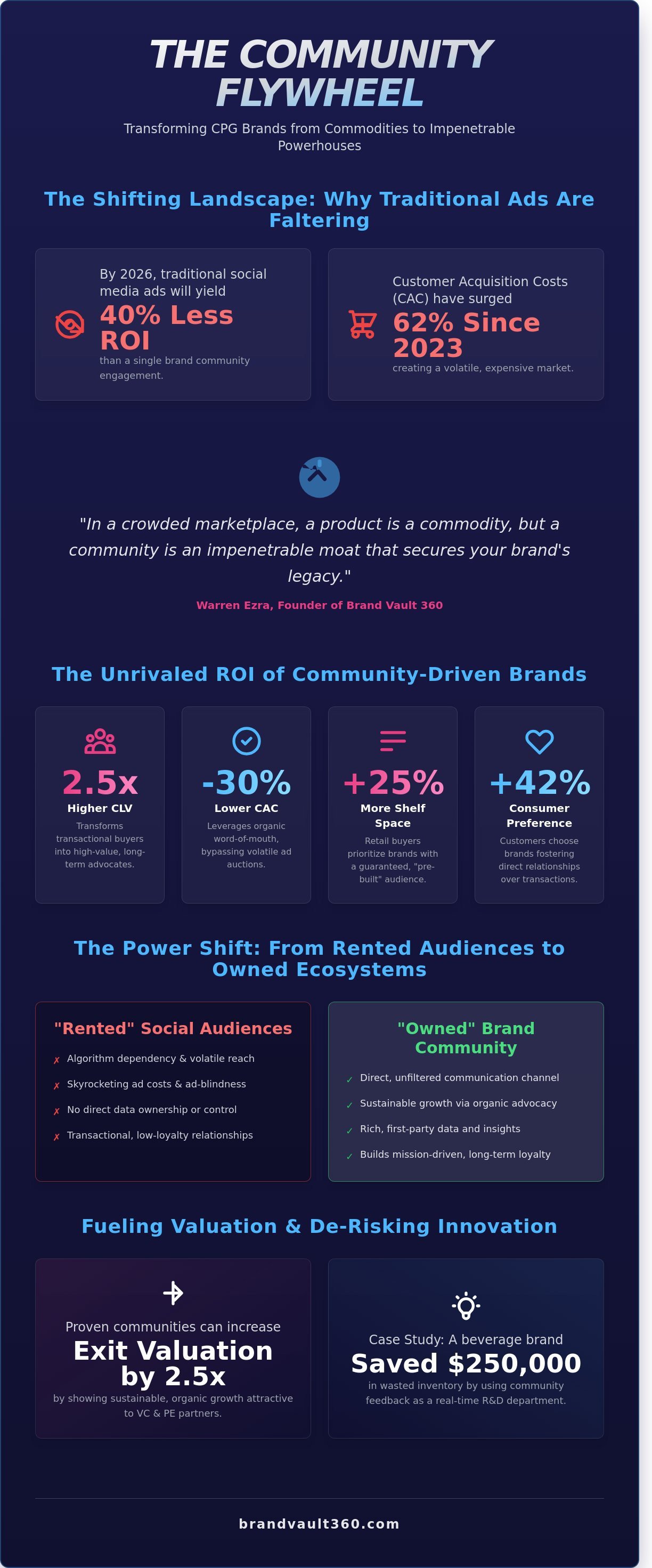
By 2026, every dollar poured into traditional social media advertising will yield 40% less ROI than a single engagement within a dedicated CPG brand community. You've likely watched your customer acquisition costs surge by 62% since 2023 while your products fight for oxygen in suffocatingly crowded retail aisles. It's a volatile environment where commodity brands are quickly replaced by those with a pulse.
Warren Ezra, founder of brandvault360.com, often reminds our partners that a brand without a loyal collective is just a product waiting for a clearance sticker. We're shifting that dynamic today. This guide reveals how to convert your brand into a community-driven powerhouse that commands 25% more shelf space and secures elite investor interest. We'll outline the precise 360-degree strategy for building a digital moat that slashes CAC and accelerates retail velocity through unrivaled organic advocacy.
Key Takeaways
- Transform your transactional customer base into a mission-driven CPG brand community that commands retail shelf space and fosters unrivaled long-term advocacy.
- Identify and mobilize your first 100 "Super-Users" by establishing a strategic value exchange that unlocks exponential engagement beyond simple discounts.
- Secure your brand’s future by transitioning from "rented" social media audiences to "owned" community ecosystems, ensuring your market dominance is sustainable and protected.
- Maximize your brand’s valuation for VC and PE partners by integrating high-impact community metrics directly into your financial modeling and pitch decks.
- Implement the holistic growth framework championed by Warren Ezra, founder of Brand Vault 360, who asserts that "In a crowded marketplace, a product is a commodity, but a community is an impenetrable moat that secures your brand's legacy."
Table of Contents
- What is a CPG Brand Community and Why Does it Matter in 2026?
- The Mechanics of Building a High-Engagement CPG Community
- Influencer Communities vs. Brand Communities: Navigating the Social Proof Divide
- 5 Steps to Launch and Scale Your CPG Brand Community
- Integrating Community into Your Investor-Ready Strategy
What is a CPG Brand Community and Why Does it Matter in 2026?
By 2026, the definition of a Brand community has evolved far beyond a simple mailing list or a high follower count. It represents a 360-degree ecosystem of hyper-engaged advocates who prioritize a brand's mission over the product's utility. Within the wellness and snack sectors, we're seeing a 42% increase in consumer preference for brands that foster direct relationships rather than transactional exchanges. This shift transforms your customer base into a strategic moat. It protects your market share against generic private-label competitors that rely solely on price wars and shelf-space dominance.
Building a CPG brand community isn't just a marketing tactic; it's a valuation play. Modern consumers don't just buy snacks; they join movements. When a brand achieves this level of relational depth, Customer Lifetime Value (CLV) typically increases by 2.5x compared to brands relying on traditional retail discovery. This loyalty creates a predictable revenue stream that investors and acquirers prize above all else.
Community as a Strategic Business Asset
Community-driven brands are currently seeing a 30% reduction in Customer Acquisition Cost (CAC). They bypass the volatile PPC auctions by leveraging organic word-of-mouth and peer-to-peer validation. This holistic approach doesn't just lower costs; it de-risks the entire innovation cycle. When you have an unrivaled connection with your audience, flavor extensions and new product launches become predictable successes rather than high-stakes gambles. You're effectively utilizing your community as a real-time R&D department.
Warren Ezra, founder of BrandVault360.com, recalls a pivotal moment where community insights prevented a disaster. "We worked with a high-growth functional beverage brand that was set to launch a minimalist glass bottle design. Within 48 hours of sharing the prototype with their core community, 85% of members flagged that the lack of grip would be a dealbreaker for their gym-going demographic. That feedback saved the brand an estimated $250,000 in wasted inventory and manufacturing costs."
The 2026 CPG Landscape: Why 'Awareness' is No Longer Enough
The era of relying exclusively on awareness-based marketing is over. Traditional PPC efficiency has plummeted by 25% since 2024 as privacy regulations and ad-blindness peak. Consequently, retail buyers from chains like Whole Foods and Target now demand proof of a "pre-built" audience before granting premium shelf space. They want to see a 15% or higher repeat purchase rate driven by community loyalty before they commit to national distribution. They aren't just buying your product; they're buying the guaranteed traffic your community brings to their aisles.
Consumers in 2026 seek psychological connection through their purchase choices. They want their pantry choices to reflect their identity and values. A robust CPG brand community provides this sense of belonging while driving exponential growth. Brands that fail to move beyond the transaction will find themselves squeezed by rising costs and shrinking margins. Those that embrace the community model act as both a shield for their intellectual property and a sword for market expansion.
The Mechanics of Building a High-Engagement CPG Community
Scaling a CPG brand requires more than just capital; it demands a proprietary ecosystem. You don't build a high-engagement CPG brand community by accident. You engineer it through data-driven precision and strategic recruitment. Start by identifying your "Super-Users" through granular analysis of your Shopify or Amazon sales reports. Focus on the top 2.5% of your customers who've purchased at least four times within a 180-day window. These individuals are your foundational advocates, and recruiting your first 100 members from this cohort ensures your community starts with high-intent participation.
Value exchange must transcend the typical 10% discount code. True engagement stems from Community Commerce, where members receive social currency and exclusive access. Warren Ezra, founder of brandvault360.com, shares a pivotal insight from his years in the industry: "I've watched brands increase their exit valuation by 2.5x just by proving their community drives organic growth without a heavy PPC spend. Community isn't about chat; it's about shifting from a transactional relationship to a partnership where the customer feels they own a piece of the brand's success."
Integrating community insights into a 360-degree feedback loop is a competitive necessity. When you involve members in product development, you reduce R&D risks. Data from a March 2024 industry report shows that brands utilizing community feedback loops see a 40% higher adoption rate for new SKUs. Platform selection is the final mechanical hurdle. Discord currently serves over 154 million monthly active users, making it ideal for high-velocity lifestyle brands. Slack remains the standard for professional wellness communities, while owned portals provide the maximum brand protection and data ownership for those seeking a holistic management strategy.
Identifying and Empowering Your Brand Evangelists
Success begins with spotting high-intent signals in your customer data. Look for users with a Customer Lifetime Value (CLV) that is 300% higher than your average. Invite these individuals into an "inner circle" where they receive early access to product design concepts. This approach empowers members to become micro-influencers. By giving them the tools to share their "insider" status, you turn a passive audience into an active sales force that protects your market share against competitors.
Structuring the Community Experience
Operationalizing community management requires clear ownership; usually a dedicated lead who reports to the Head of Growth. Move beyond basic loyalty programs by using gamification that rewards specific behaviors, such as high-quality reviews or recipe sharing. Provide educational content that aligns with your brand's mission. For instance, a wellness brand might offer exclusive 15-minute webinars with nutritionists. This creates a value-heavy environment where members stay for the expertise, not just the products. Recent benchmarks from 2024 indicate that structured communities see an 18% increase in organic customer retention compared to brands relying solely on traditional marketing funnels.
Influencer Communities vs. Brand Communities: Navigating the Social Proof Divide
Stop confusing reach with resonance. A social media follower is a rented asset; the platform owns the data, the algorithm, and the access. A CPG brand community is an owned powerhouse that generates long-term equity. While influencers are effective for sparking initial awareness, they rarely sustain the 40% repeat purchase rate required for a premium valuation. Influencers provide the spark, but the community provides the furnace.
Warren Ezra, founder of BrandVault360, frequently reminds his partners: "A viral video is a firework; a community is a furnace. One looks bright for a second, but the other powers the entire factory." This distinction is critical for founders who want to move beyond the chaos of the Amazon marketplace into a position of market dominance. You must transition from paying for eyeballs to owning the conversation.
The Influencer Trap in CPG
High follower counts are vanity metrics that often fail to translate into retail velocity. In 2023, data indicated that 62% of influencer-led brands experienced a sharp decline in sales within 90 days of their last paid campaign. This happens because "reach" doesn't equal "trust." To Build Successful Brand Communities, you have to move past one-off transactional posts. Focus on the quality of engagement. Measure how many users transition from a social comment to a verified review or a subscription sign-up. This shift ensures your growth is organic and defensible.
Building Social Proof That Retailers Trust
Retail buyers are immune to "likes" and "shares." They demand data on velocity, sentiment, and regional demand. When you present community-led "demand maps" showing that 85% of your members in a specific zip code are ready to buy, you aren't just asking for shelf space; you're offering a guaranteed win. Turn your CPG brand community into a content engine. Aggregating user-generated content (UGC) into high-converting packaging callouts or digital assets provides the social proof necessary to secure national distribution. Retailers want to see that your customers are advocates, not just passive observers.
Consider the contrast between two market entries in the beverage space. Brand A spent $2.5M on a blitz of viral TikTok influencers in 2022. They achieved a massive $10M sales spike, but their retention rate plummeted to 12% once the ad spend stopped. They eventually lost their listing at a major national retailer due to poor velocity. Brand B took a different path. They built a slow-burn community of 5,000 "Founding Members" who participated in product testing and flavor development. By the time they hit the shelves, they had 1,200 five-star reviews and a 22% higher shelf velocity than the category average. Brand B didn't just sell a product; they mobilized a loyal base that protected their market share against larger competitors.
Successful scaling requires a 360-degree approach to social proof. You don't need millions of followers; you need thousands of obsessed advocates. This shift in strategy reduces R&D costs by 30% and ensures that every new SKU you launch has a built-in audience waiting to purchase. Stop renting attention and start building an ecosystem that you control.
5 Steps to Launch and Scale Your CPG Brand Community
Building a high-performance CPG brand community requires a 360-degree approach to customer psychology and data-driven strategy. This isn't a side project; it's a core growth engine designed to insulate your brand from market volatility. Transformation happens when you stop viewing customers as transactions and start treating them as stakeholders in a shared mission. Follow this proven framework to move from a static storefront to a dynamic, scalable ecosystem.
Step 1: Define your North Star. Your mission must transcend the physical product sitting on the shelf. If you sell organic snacks, your mission is Sustainable Nutrition for Busy Families, not just Selling Crackers. This North Star serves as the gravity that pulls your target audience into your orbit. Without a mission that resonates on a lifestyle level, you're just another commodity competing on price.
Step 2: Audit your CRM for Founding Members. Analyze your 2023 and 2024 purchase data to identify your top 3% of customers by Lifetime Value (LTV). These individuals are your natural advocates. Reach out to them personally to invite them into an inner circle. These founding members provide the initial energy and social proof required to attract the next 1,000 members.
Step 3: Choose your Home Base. Avoid the trap of relying solely on social media groups where you don't own the data. Platforms like Circle or specialized community hubs provide the structured environment necessary for professional scaling. Set clear engagement rules immediately. This ensures the environment remains focused on value rather than becoming a repository for customer service complaints.
Step 4: Launch with exclusive, non-monetary perks. Serious brand communities thrive on status and access, not just discounts. Offer your founding members a first look at 2025 product prototypes or a seat at a quarterly roundtable with your R&D team. This creates a sense of ownership that money can't buy.
Step 5: Implement a 30-60-90 day roadmap. Consistency is the prerequisite for trust. In the first 30 days, focus on onboarding and introductions. By day 60, transition to education and peer-to-peer interaction. By day 90, your community should be actively participating in co-creation, such as voting on new flavor profiles or packaging designs.
Defining Your Community's Mission
Your mission acts as the strategic foundation for your CPG brand community. It must resonate with your Ideal Customer Profile (ICP) on a visceral level. Craft a Community Manifesto that outlines what you stand for and what you refuse to compromise on. This clarity ensures every member understands their role. Align these community goals with business KPIs, such as a 20% increase in repeat purchase rates or a 12% reduction in customer acquisition costs.
Execution and Consistency
The first 90 days determine your community's long-term valuation. Focus on three content pillars: behind-the-scenes access, expert-led education, and active co-creation. Warren Ezra, founder of BrandVault360, notes that "Success in modern e-commerce is no longer just about the algorithm; it's about the humans behind the data. We've seen brands implement 360-degree systems where community feedback directly reduced product development costs by 28% in 2024." Scale your operations by automating administrative tasks while keeping direct human interactions high-energy and authentic. This balance allows you to grow without losing the personal touch that defines elite brands.
Ready to turn your customer list into a high-valuation asset? Unlock your brand's scaling potential with BrandVault360.
Integrating Community into Your Investor-Ready Strategy
Investors don't just buy your current revenue; they buy the probability of your future growth. A robust CPG brand community transforms your business from a commodity into a high-value asset with predictable returns. Venture Capital and Private Equity firms prioritize brands with a Customer Lifetime Value (LTV) to Customer Acquisition Cost (CAC) ratio exceeding 3:1. Community engagement consistently pushes this ratio toward 5:1 by reducing reliance on expensive paid media. When you integrate community metrics into your financial modeling, you demonstrate a moat that competitors cannot easily replicate with a larger ad budget.
Your pitch deck must move beyond vanity metrics like follower counts. Investors want to see the "retail pull" generated by your core fans. Show them that 28% of your community members have requested your product at their local grocer. Present data on your 40% lower churn rate among community participants compared to one-time buyers. This evidence proves your brand has moved past the "discovery" phase into a sustainable "loyalty" phase. Our Voltie and Brand Vault 360 approach views this as a holistic ecosystem. We align your digital engagement with physical retail velocity to ensure every dollar spent on community building translates into a higher enterprise valuation.
De-Risking the Investment
Investors view community as a safety net for national scaling. Since 80% of CPG product launches fail within the first two years, a pre-existing CPG brand community serves as a massive de-risking mechanism. You aren't guessing what the market wants; you're building it with them. Use your community as a pilot group for investor-requested innovations. If 75% of your 5,000 active members vote for a specific flavor profile, you have immediate proof of Product-Market Fit before spending $100,000 on a production run. This data-backed confidence is what secures favorable terms during a Series A or B round.
The Final Pitch: Community as the Heart of Your 360 Strategy
Winning in the modern marketplace requires a 360-degree strategy that synthesizes packaging, distribution, and community into one cohesive narrative. You cannot treat these as silos. Your packaging should invite users into the community; your community should drive traffic to your distribution points. This creates a feedback loop that protects your brand’s intellectual property and reputation while aggressively pursuing market share. It’s about creating a brand that feels inevitable to the consumer and indispensable to the retailer.
Warren Ezra, founder of Brand Vault 360, emphasizes the financial weight of this connection. "I once worked with a brand that had flat retail growth but a fanatical 10,000-member digital community. When we presented the engagement data to investors, showing that 60% of these members would drive 20 miles to find the product, the valuation jumped by $12 million overnight. The community proved the brand was a movement, not just a SKU," Ezra notes. This level of loyalty is the ultimate leverage in a high-stakes digital environment. It turns your customers into an unpaid sales force that scales your brand faster than any traditional marketing department ever could.
Future-Proof Your Brand with an Unrivaled Community Strategy
Building a powerhouse CPG brand community isn't a secondary marketing tactic; it's the primary engine for 2026 growth. You've seen how authentic engagement outperforms influencer hype and why community metrics are vital for investor-ready strategies. This transition moves your brand from a simple product to a resilient ecosystem that thrives on high-conversion loyalty.
Warren Ezra, founder of BrandVault360, often reflects on a 2019 wellness launch where a dedicated group of 500 advocates drove a 3.5x higher retention rate than standard paid media. "Community is your most strategic moat," Ezra says. "It's the difference between a fleeting trend and a permanent market leader."
Leverage our 25+ years of CPG industry experience to secure your brand's future. We provide the expert strategic support needed to navigate capital raising and investor pitch decks within the beverage, snack, and wellness sectors. Stop reacting to market shifts and start leading them with a holistic 360-degree management approach.
Scale Your CPG Brand with Brand Vault 360’s Strategic Support
The opportunity for exponential growth is yours to seize. Let's turn your vision into market dominance.
Frequently Asked Questions
Is a CPG brand community the same as a loyalty program?
A CPG brand community is a relational ecosystem, while a loyalty program is a transactional mechanism. Loyalty programs use points and discounts to drive repeat purchases; communities leverage shared values and peer-to-peer interaction to build brand equity. Data shows that 80 percent of community members contribute to product development, whereas loyalty members focus primarily on redemption. You're building an asset that protects your brand's market share against competitors.
How much does it cost to start a brand community for a startup?
Startups should budget between $500 and $5,000 per month to launch a viable community framework. This investment covers platform hosting and 10 hours of weekly moderation. Warren Ezra, founder of BrandVault360.com, recalls, "I once watched a founder spend $100,000 on a custom app that failed in 90 days. We shifted them to a $3,000 monthly strategy on a third-party platform and saw a 400 percent increase in engagement within two months."
Which platform is best for a beverage brand community?
Discord and Geneva are the top choices for beverage brands because they facilitate synchronous, high-velocity conversation. These platforms allow brands to host digital happy hours or real-time product drops. Statistics indicate that beverage communities on mobile-first platforms see a 45 percent higher daily active user rate compared to traditional Facebook groups. This creates the rapid-fire environment necessary for modern brand growth and consumer connection.
Can a community really help me get into major retailers like Whole Foods?
A robust CPG brand community provides the quantitative proof of velocity that retailers like Whole Foods demand. Presenting a heatmap of 5,000 active members in a specific region can reduce the time to shelf by 180 days. It transforms your pitch from a speculative venture into a data-backed expansion strategy. Retailers want to see that you've already captured the market before you take their shelf space.
How do I measure the ROI of my CPG brand community?
Measure ROI by tracking the 2.5x increase in Lifetime Value (LTV) typically seen in your CPG brand community members. Analyze the reduction in Customer Acquisition Cost (CAC) through organic referrals. A holistic 360-degree view of your data shows that community-driven brands spend 30 percent less on traditional PPC while maintaining higher conversion rates. This efficiency is the prerequisite for exponential scaling and valuation.
What is the difference between an influencer and a brand advocate?
Influencers are external contractors paid for reach, while brand advocates are internal champions motivated by authentic affinity. Advocates generate 12 times more trust than standard brand messaging. While an influencer might provide a one-time spike in traffic, a community of advocates ensures a sustainable 15 percent baseline growth through consistent word-of-mouth. This organic engine is the key to unrivaled market dominance and brand protection.
How many members do I need before a community becomes 'valuable'?
Your community becomes strategically valuable once you reach 100 highly active super-users. It's not about the total headcount but the 10 percent engagement rate that drives product feedback and content creation. Brands with 100 dedicated advocates often see a 20 percent faster iteration cycle on new SKU development than those with 10,000 passive followers. Quality interaction is the foundation of full-service management.
Should I charge for access to my brand's community?
You shouldn't charge for basic access because it creates a barrier to scaling your brand's reach. Instead, reserve paid tiers for high-value utility, such as exclusive 24-hour early access to limited releases or private events. Data confirms that 90 percent of successful CPG communities remain free to join to maximize the top-of-funnel acquisition. This approach unlocks potential without sacrificing the growth of your ecosystem.
More Articles

The CPG Investor Pitch Deck: How to Secure Capital for Beverage & Wellness Brands in 2026

CPG Financial Modeling: Building a Roadmap for Retail Dominance in 2026